English (United Kingdom)
  Deutsch (Deutschland)
  Français (France)
  Magyar (Magyarország)
  Italiano (IT)
  Slovenščina (SL)
  Svenska

November 2025
“Wait, I’ll show you.”
Katarina said this almost spontaneously when she noticed that Peter was having trouble inserting an image into a document. A few weeks earlier, she herself had asked for help with the same task.
Now she leaned toward him and calmly explained: “First you click here, then you select the file.”
Peter followed her instructions. The image appeared on the screen. They both smiled.
That moment wasn’t planned. It wasn’t part of the curriculum. It was the result of a process that had been unfolding quietly: the transition from individual learning to collective progress.
Knowledge used to be a competition
For a long time, school systems were based on individual achievement. Grades were personal. Success was measured individually. Helping a classmate was sometimes seen as a weakness or even a violation of the rules.
The digital environment, however, is based on collaboration. Platforms enable collaborative document editing, sharing of materials, commenting, and remote collaboration.
But technology alone does not create collaboration. A culture is needed.
DigComp Competence 2.4—collaboration using digital technologies—includes the ability to share knowledge, support others, and use digital tools for collaborative work.
From “I don’t know how” to “I’ll show you”
When Katarina first tried to insert an image into a document, she was unsure. She was afraid she would “mess something up.” She needed help, and she accepted it.
This experience wasn’t just technical. Once she mastered the process on her own, she gained something more: the realization that she could do it.
And when she saw that someone else was having the same problem, she reacted naturally. Not as an expert, but as someone who had gone through the same process.
Collaboration in a digital environment isn’t just about sharing files. It’s about sharing a journey.
Technology as a Shared Space
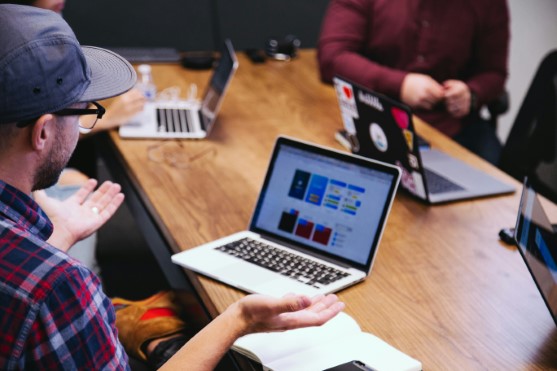
At UPI Žalec, we are increasingly using shared documents where multiple participants can contribute content simultaneously. At first, there was some hesitation. Who will write what? What if I delete someone else’s work?
But gradually, they began to understand the logic of a shared space. The document no longer belongs to an individual, but to the group.
When one person adds a paragraph, another expands on the idea. When one corrects a mistake, another suggests an improvement.
Collaboration becomes a process, not a task.
Reflection within the organization
Even among our professional staff, we asked ourselves how we encourage mutual support. Are we creating an environment where knowledge sharing is second nature? Do we recognize the moments when participants take on the role of mentors?
The project encouraged us not only to notice such moments but also to highlight them. Not with a reward, but through reflection.
When a participant helps another, the role changes. They are no longer just a recipient of knowledge. They become its bearer.
Community as a result of learning
At the end of that session, Mr. Peter said: “Thank you, next time I’ll be the one to help someone else.”
This was not a promise, but a natural consequence of the experience.
Digital competence does not develop in isolation. It grows within a community. When an individual sees that they can contribute, the group dynamic changes.
At UPI Žalec, we have learned through practice that one of the strongest indicators of progress is precisely this: the moment when help is no longer reserved for the teacher.
When participants begin to help one another, the digital environment becomes a space for collaboration, not just learning.
And perhaps this is one of the most lasting changes—the realization that knowledge is not something we keep to ourselves, but something that grows through sharing.