English (United Kingdom)
  Deutsch (Deutschland)
  Français (France)
  Magyar (Magyarország)
  Italiano (IT)
  Slovenščina (SL)
  Svenska

September 2025
“My grandson showed me how to do this.”
Mr. Milan said this with a touch of pride when, during the workshop, he opened a photo-sharing app and effortlessly created a shared folder. A few participants looked at him in surprise.
“Really?” asked the woman next to him. “And did he patiently explain it to you?”
“Of course,” he replied. “He teaches me about computers, and I teach him about life.”
Laughter filled the room. But there was more to that statement than just a joke.
Knowledge used to flow in one direction
Traditionally, we associated knowledge with age. The older taught the younger. Experience was passed down. Authority was tied to age.
The digital revolution has shifted this dynamic. Younger generations have grown up with screens. They pick up new apps faster. They intuitively understand certain interfaces.
But that doesn’t mean they have more life experience.
When Mr. Milan says he learned something from his grandson, he isn’t talking about a loss of authority. He’s talking about a shift in the flow of knowledge.
Collaboration as a Two-Way Process
DigComp Competence 2.4—collaboration using digital technologies—goes beyond technical group work. It involves a willingness to accept that knowledge comes from various sources.
At UPI Žalec, we often hear stories about grandchildren helping their parents or grandparents set up a phone, open an account, or send a photo. At first, there is a slight sense of awkwardness in these stories. But then, more and more often, pride takes over.
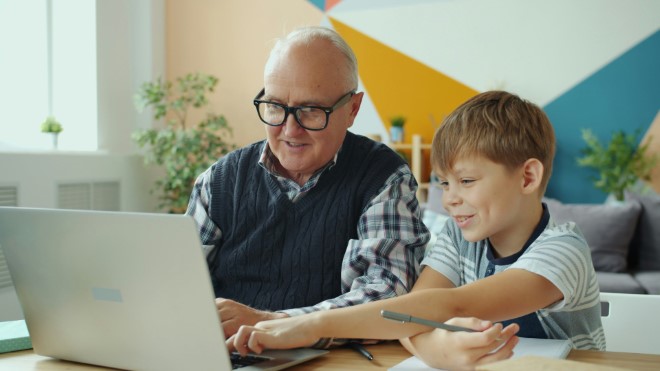
Intergenerational learning is not one-way. When younger people demonstrate a digital function, older people offer context, experience, and critical judgment.
Technology as a bridge, not a divide
We often hear that technology creates a generation gap. But in practice, we see the opposite.
When Mr. Milan shares photos with his family, he is no longer dependent on intermediaries. He can participate in conversations, comment, and share memories.
Digital collaboration becomes a way to maintain relationships.
At one of the workshops, we asked participants to describe a situation where they had learned something digitally from younger people. The stories were similar: phone settings, using video calls, searching for information.
But something else was interesting. When they described these moments, they didn’t talk about technology. They talked about relationships. About patience. About time spent together.
Reflection within the organization
As an educational institution, we had to consider how to incorporate intergenerational dynamics into the learning process. Do we provide opportunities for exchange? Do we encourage participants to share their experiences?
The project encouraged us to have more open conversations. To recognize that digital competence is not tied to one’s year of birth.
When a participant says they learned something from their grandson, it is not a sign of a deficit. It is a sign of openness.
A Shift in Perspective
At the end of the workshop, Mr. Milan helped another participant create a shared folder. The steps he had previously received from his grandson became knowledge he could pass on.
Thus, the circle is complete.
Digital collaboration is not a competition between generations. It is an exchange. When we accept that we can learn from one another—regardless of age—the digital space becomes a shared space.
And perhaps this is one of the most important lessons: that competence is not tied to age, but to a willingness to collaborate.
When knowledge flows in both directions, technology does not divide. It connects.