English (United Kingdom)
  Deutsch (Deutschland)
  Français (France)
  Magyar (Magyarország)
  Italiano (IT)
  Slovenščina (SL)
  Svenska

December 2024
Sweden is often described as one of the world’s most digital societies. People pay with their phones, sign documents with BankID, manage healthcare through 1177, attend digital meetings from remote villages, and interact with public authorities through fully online systems. Digitalisation has become so deeply embedded in everyday life that many no longer even think about it.
But this digital success also hides a growing reality: not everyone in Sweden is keeping pace. Beneath the surface of innovation lies a quieter challenge—large groups of adults lack the digital competence needed to participate fully in society, access essential services, or keep up in a rapidly changing labour market. And as Sweden moves further toward automation, digital public administration, and AI-driven tools, the consequences of this gap become more visible.
This is why integrating the DigComp framework into adult education is not just beneficial—it is essential for Sweden’s future.
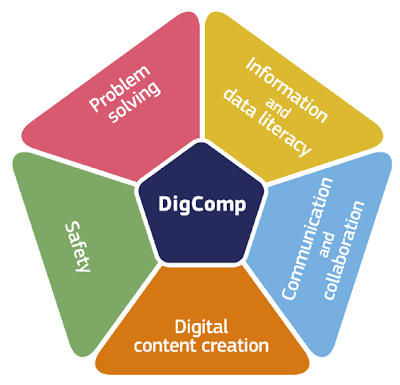
Digital competence today is not simply about using a computer. It is about understanding information, communicating safely, solving problems online, protecting one’s identity, navigating digital workplaces, and recognising misinformation. Yet many adults struggle in exactly these areas. Seniors feel discomfort when the pharmacy no longer accepts cash. Migrants are overwhelmed by digital identification systems they must master immediately. Jobseekers encounter applications that require digital literacy they never developed. Even experienced workers find themselves suddenly expected to use new platforms, data tools, or digital interfaces without training.
Sweden’s rapid digitalisation has created a paradox: the more technologically advanced the country becomes, the more damaging digital exclusion becomes for those left behind.
What Sweden needs is a shared foundation for defining, teaching, and assessing digital skills. DigComp provides exactly that. It offers a clear structure describing what digital competence means today—from information literacy to problem-solving—and it breaks these competences down into progressive, practical levels that educators and learners can understand. Instead of scattered interpretations of what “digital skills” are, DigComp gives Sweden a common language.
By integrating DigComp into adult education, Sweden can ensure that learning is not dependent on where a person lives, which provider they meet, or what background they have. It creates equality. It creates clarity. And it creates a pathway for adults who need to strengthen their skills in a world where digital participation is no longer optional.
DigComp is especially relevant to Sweden because the country’s most vulnerable groups are also those most affected by digitalisation. Newcomers must use digital services from day one but often lack the familiarity to do so confidently. Low-skilled adults face a labour market that increasingly requires digital tasks even in entry-level jobs. Seniors risk isolation as everyday activities—from banking to grocery orders—shift online. And people transitioning between careers must rapidly learn digital tools to remain employable.
When adult education providers adopt DigComp, these individuals receive structured, understandable, and empowering support. They can see what skills they have, what they need, and how to progress. Educators can design learning paths that make sense. Employers can better interpret learners’ capabilities. Society as a whole becomes more inclusive.
Moreover, Sweden’s labour market—one of the most innovative in Europe—demands continuous upskilling. Automation, data-driven decision-making, digital teamwork, and AI tools are transforming workplaces at extraordinary speed. Without a national approach to strengthening adult digital competence, the risk is not only individual exclusion but a weakening of Sweden’s competitive edge.
DigComp helps prevent this. It supports adults in building digital confidence, adaptability, and lifelong learning habits that keep them active participants in both society and the economy.
Ultimately, integrating DigComp into adult education is not about technology—it is about people. It is about ensuring that every person in Sweden, regardless of age, background, or previous education, can participate fully in a society that increasingly operates online. It is about fairness, inclusion, and opportunity.
Sweden has the infrastructure, the innovation capacity, and the commitment to lifelong learning. What it needs now is a unified, human-centered approach to digital competence. DigComp provides the roadmap. Adult education provides the bridge. And together, they create the possibility of a Sweden where digitalisation benefits everyone—not just those who already feel at home in the digital world.