A three years project to explore ways of considering digital competences of citizens in their learning activities
In a world where computer technology increasingly influences all aspects of life, citizens must possess the skills to navigate devices, data, and everything digital.
In order to get a better grip on such skills, various attempts have been made to describe the skills systematically. One of these attempts is DigComp, the European reference framework for digital competences of citizens. It has been developed by experts on behalf of the European Union, with the first edition published in 2013, and subsequent updates in later years. Current version (as in 2025) is DigComp 2.2.
The DigCompAE project — a Partnership for Cooperation in Adult Education under the roof of the Erasmus+ programme of the EU — is an attempt to finally make use of DigComp in the area of adult education. It is about finding out – and testing – if and how digital skills of citizens can be considered systematically in the planning and delivery of adult education, based on integrating skills definitions as provided by DigComp into everday work process in adult education organisation.
Conretely: this is about adjusting the planning and delivery of adult education so that in every stage of the process digital skills of citizens (customers, learners, the beneficiaries of organised education) are taken into account. This should be done not only in areas of education that obviously ask for digital skills (e.g. any form of computer courses) but also in areas prima vista not related to computers, e.g. cooking and houshold courses, language courses, or health-related topics such as Yoga and other forms of physical exercise.
The idea is that educators and teachers at any stage of their work try to be aware of digital skills either needed for participating in the course or digital skills that will be developed by learners participating in the activities. If such skills are identified for a certain learning offer (course, workshop, etc.), it would be good practice to make this transparent in the information material for the respective course so that everybody, including customers (learners) can easily see if and how this given course might relate to digital skills.
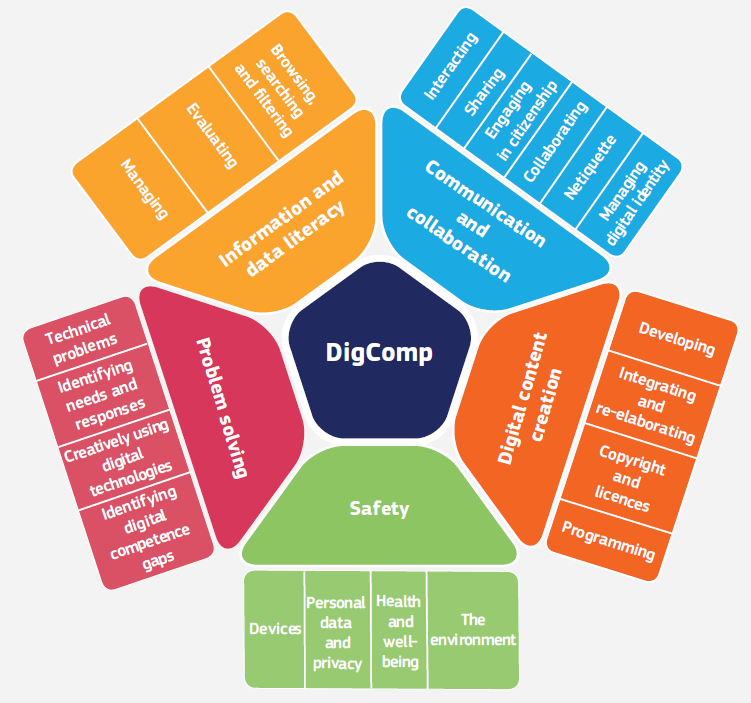 DigComp diagram showing the five areas and the 21 competences. This diagram was published in the 2020 "DigComp at Work" document, Page 7. (Document available in our Library section.)