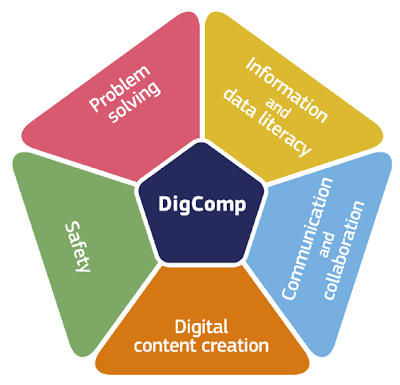
Development of an icon for course classification
November 2025 In order to visualize the course classification of lecturers and program area managers in DigComb 2.3 AT, we began developing icons in the fall of 2025 and finally found a current draft.
Live reporting about our attempts to integrate DigComp into our adult education organisation. Here: Folkuniversitetet Uppsala, Sweden.
Sweden’s labour market is changing faster than at any point in recent decades. Automation, artificial intelligence, and digital workflows are no longer future trends they are already shaping how work is organised, evaluated, and performed. For Swedish employers, digital competence has quietly shifted from a specialised skill to a basic condition for employability, and this shift is creating a new and often underestimated gap.
In today’s Sweden, digital competence is expected across sectors. Warehouse employees work with digital inventory systems. Healthcare assistants document care through digital platforms. Construction workers use apps for scheduling and reporting. Retail staff manage payments, logistics, and customer communication through digital tools. Even roles traditionally described as “manual” are now technology-mediated work environments.
As one Swedish employer put it:
“We no longer hire based on what tools someone knows. We hire based on how quickly they adapt when the tools change.”
This statement captures the essence of the new digital competence gap. Employers are not simply looking for people who can use software they are looking for workers who can think digitally, solve problems in digital contexts, evaluate information critically, and collaborate confidently through digital platforms.
What employers increasingly expect is digital competence as a transversal skill. This includes the ability to:
Automation and AI intensify these expectations. As routine tasks are increasingly handled by algorithms and machines, human workers are expected to manage exceptions, interpret outputs, and make informed decisions. This shifts the value of work toward judgement, flexibility, and digital problem-solving capacity.
An HR specialist in Sweden describes it this way:
“Digital skills are no longer a ‘nice-to-have’. They sit alongside communication and teamwork as core employability skills.”
Despite Sweden’s strong education system, a large part of the adult workforce did not acquire these competences through formal learning. Many entered the labour market before digital tools became central to work. Their skills developed informally, unevenly, or not at all.
The result is a growing skills mismatch. Employers report recruitment difficulties, not because workers are unavailable, but because applicants lack the digital confidence needed for modern workplaces. At the same time, many adults underestimate how much digitalisation has reshaped their profession until they encounter new systems at work and feel unprepared.
“The biggest gap we see is not advanced technical knowledge,” notes an adult education expert, “but confidence. People hesitate, second-guess themselves, and fear making mistakes.”
This hesitation has real consequences. Workers with low digital competence face a higher risk of unemployment, underemployment, and job insecurity. Employers experience slower innovation, higher onboarding costs, and resistance to change. At a societal level, the gap threatens labour market adaptability and workforce digital resilience.
Sweden’s economy depends on innovation, flexibility, and continuous learning. A workforce divided between those who can adapt digitally and those who cannot weakens not only individual careers, but national competitiveness. Digital competence has become a form of economic infrastructure invisible when it works, but critical when it is missing.
The challenge is compounded by the fact that employer expectations are often implicit. Digital competence is assumed rather than clearly defined. Employees are expected to “pick it up” on the job, adapt independently, and learn continuously often without structured support. This benefits those with prior exposure to digital environments and disadvantages others, particularly older workers, low-skilled adults, and people changing sectors.
“We are no longer hiring for what people know,” one employer explains, “but for how they learn.”
The digital competence gap is not about resistance to technology. It is about alignment between employer expectations, workforce skills, and lifelong learning opportunities. Evidence shows that adults learn digital skills most effectively when learning is structured, practical, and directly connected to real work tasks.
From a labour market perspective, investing in adult digital competence supports:
In today’s Swedish labour market, digital competence is no longer a profession-specific skill. It is a condition for participation. Employers expect workers who can adapt, collaborate with technology, and navigate uncertainty with confidence. Without a digitally prepared adult workforce, innovation slows, inequality grows, and opportunities narrow.
Closing the digital competence gap is therefore not only a workforce issue it is a strategic choice about the kind of labour market Sweden wants to build. One that leaves people behind, or one that equips them to move forward alongside technology.

In today’s Sweden, the simple act of paying for a coffee or buying groceries has become a digital experience. Cards replace cash, Swish replaces coins, and apps guide everything from travel to communication. For many people this transition feels natural—even liberating. But for a growing number of older adults, Sweden’s rapid move into a cashless, digital society has created a quiet sense of anxiety and exclusion that is easy to overlook unless you are experiencing it yourself.
Imagine an older man standing at the checkout counter of a supermarket. He reaches into his wallet for cash only to see a sign: “Vi tar inte emot kontanter.” The cashier smiles politely, but the message is clear—he must pay digitally or not at all. He fumbles with his card, unsure if he has inserted it correctly, aware of the people waiting behind him. What once felt simple now becomes a moment of stress.
Or picture a woman in her seventies trying to travel to visit a friend. The SL ticket machines no longer accept cash, and the SL app (https://sl.se) requires scrolling, choosing zones, and understanding symbols she has never seen before. She hesitates at every step, afraid to buy the wrong ticket. A trip meant to bring joy begins with uncertainty.
These moments are not rare. They unfold in cafés, pharmacies, buses, and living rooms across the country. Older adults are asked to adapt quickly in a world where paying bills happens online, electricity prices are tracked through digital dashboards, and recycling schedules are posted only on municipal websites. Even staying in touch with family now involves Facebook groups, WhatsApp chats or video calls—platforms that feel unfamiliar and risky to many seniors.
For older adults, the issue is rarely resistance. It is confidence. They worry about pressing the wrong button, clicking a fake link, paying twice, or accidentally sharing personal details. They feel embarrassed asking for help, ashamed that something so “simple” seems so complicated. Many begin avoiding tasks that require digital skills, even when those tasks are essential for independence.
This lack of confidence becomes more than a practical inconvenience—it affects well-being. Seniors who struggle digitally may lose a sense of autonomy, relying on others for tasks they once managed themselves. They may feel isolated when social life shifts into digital spaces they do not understand. They may feel left behind in a country that is moving forward at a speed they cannot match.
The problem is not the seniors—it is the pace of digitalisation and the assumption that everyone can keep up. Sweden’s digital systems are advanced and efficient, but not always designed with older users in mind. Interfaces are often crowded, instructions unclear, and security steps intimidating. Without support, many seniors quietly withdraw from activities they enjoy.
That is why building digital confidence among older adults is so important. When seniors receive patient, hands-on guidance, they often learn faster than expected. When someone explains not only how to do something but why it works that way, digital tools stop feeling like threats and start becoming useful. And when confidence grows, everything changes: paying for transport, managing appointments, staying connected, and accessing information all become more manageable and less stressful.
Digital confidence is not about making seniors “tech experts.” It is about dignity, independence, and participation. Sweden’s shift toward a digital and cashless society offers many benefits—but only if those benefits are accessible to everyone.
If Sweden wants to remain an inclusive digital nation, it must ensure that older adults are not left standing at the doorway of a world they feel afraid to enter. Supporting seniors in building digital confidence is not just practical—it is a moral responsibility. It sends a clear message: no matter how fast society changes, everyone deserves to feel safe, capable, and welcome in it.
Sweden’s labour market is undergoing one of the most significant transformations in its modern history. Automation, artificial intelligence, and digital workflows are reshaping how people work across almost every sector, from healthcare and logistics to manufacturing and administration. What once were stable job descriptions are now evolving into roles that demand flexibility, technological awareness, and the ability to navigate digital systems with confidence. As machines take over routine tasks and digital tools become central to everyday work, the demand for human skills is changing at a speed that many adults struggle to match.
Digital competence is no longer limited to IT specialists. Warehouse workers are expected to operate digital inventory systems; cleaners use mobile apps to receive tasks and log their work; healthcare assistants rely on digital patient records; construction teams use digital planning tools; and service employees handle communication through digital platforms rather than paper forms. Even jobs traditionally seen as “hands-on” now require interaction with software, sensors, automated systems, and online communication tools. In this context, digital skills become a basic requirement, comparable to literacy or numeracy.
Automation and AI do not only replace tasks—they reshape entire professions. Routine administrative work is increasingly handled by intelligent systems. AI-driven tools analyse data faster than any human could. Predictive technologies support decision-making in everything from customer service to public planning. For adults who have spent years in the workforce, the sudden expectation to master new tools can feel overwhelming. But without these skills, workers risk losing access to jobs that once felt secure.
Sweden’s economic competitiveness relies heavily on its ability to innovate, adapt, and remain at the forefront of technological change. Companies need employees who can navigate digital environments, work effectively with automated systems, interpret data, and continuously learn new tools. The idea of “learning once and working forever” is no longer viable. Today’s labour market demands continuous upskilling, especially for adults who did not grow up in a digital world or who have limited experience with modern technologies.
Adult education plays a crucial role in this transition. It provides a safety net for workers whose jobs are changing, and a pathway for those seeking new opportunities in digital professions. Without accessible training opportunities, the gap between those who can adapt and those who cannot will grow wider, creating a divide not only in skills but in economic security and social participation. Digital competence is increasingly tied to employability, career mobility, and earning potential.
This shift is particularly challenging for low-skilled adults, who are disproportionately affected by job automation. Roles that require repetitive or manual tasks are among the first to be transformed by digital systems. Yet these workers are also the least likely to participate in further training, often due to time constraints, financial pressures, or lack of confidence. If Sweden wants a resilient and inclusive labour market, it must ensure that digital training is accessible, practical, and tailored to the needs of those most at risk of being left behind.
AI-driven workplaces also require new competencies beyond basic technical skills. Workers must understand digital communication norms, manage online information, protect personal data, and collaborate through digital platforms. Problem-solving, creativity, and adaptability become even more valuable in environments where machines handle routine tasks. The more technology advances, the more important human judgement, social skills, and critical thinking become. But these human skills can only flourish when individuals feel confident navigating digital tools.
In short, Sweden’s future labour market depends on the digital preparedness of its adult population. Without widespread digital competence, Sweden risks creating a workforce split into two groups: those who can thrive in digital environments and those who gradually lose their place in a rapidly changing economy. Upskilling is not simply about keeping pace with technology—it is about securing human dignity, opportunity, and resilience in a world that rewards adaptability.
To ensure long-term economic growth, social cohesion, and equal opportunities, Sweden must invest in continuous digital learning for adults. The workers of today—and the workers of tomorrow—need an education system that evolves alongside technology, giving every individual the chance to participate fully in the labour market of the future. Strengthening digital skills is ultimately a commitment to people, to inclusion, and to a sustainable future where technological progress is matched by human capability.
Sweden is often viewed as one of the world’s most digital nations—a place where banking, healthcare, public services, communication, and even daily errands happen online with ease. Yet behind this reputation lies a growing issue that is easy to overlook: not everyone in Sweden is keeping up with digitalisation. Despite the country’s advanced infrastructure and digital-first approach, large groups of adults still lack the skills needed to navigate everyday digital tasks, and the consequences of this gap are becoming increasingly serious.
The digital divide in Sweden affects several vulnerable groups in different ways. Seniors, for example, face enormous challenges as society becomes increasingly cashless and service-oriented through apps and online platforms. Many older adults feel insecure using BankID, managing medical information on 1177, or distinguishing safe communication from online scams. What for younger generations feels straightforward can, for seniors, be intimidating and disorienting. When they struggle digitally, they risk losing not only practical access to services but also independence, confidence, and participation in social life.
Migrants arriving in Sweden encounter another layer of difficulty. From their first day, they are expected to navigate one of Europe’s most digitalised systems. They must search for jobs online, submit forms to authorities, register for healthcare, communicate with public agencies, and understand platforms that are part of Swedish daily life but unfamiliar to them. Language barriers, cultural differences, and the complexity of digital identification systems create obstacles that can turn essential tasks into overwhelming challenges. Instead of supporting integration, digital tools can inadvertently make it harder.
Low-skilled adults also face rising pressure from a labour market transformed by automation and digitalisation. Jobs that previously required little or no digital interaction now depend on digital dashboards, scheduling apps, communication platforms, and online reporting systems. Without digital skills, workers risk losing access to employment opportunities or being unable to adapt to new workplace expectations. This growing digital competence gap directly affects job security, mobility, and long-term employability.
In rural areas, the situation is different but no less important. Despite strong national investments in broadband infrastructure, digital inclusion cannot be achieved through connectivity alone. Adults in remote areas often have fewer opportunities for training, less exposure to digital tools, and limited access to support. Even with fast internet, many feel disconnected from Sweden’s rapidly evolving digital society simply because they have not had the chance to learn the skills they need.
The digital divide in Sweden is not merely a technical issue—it affects people’s rights, well-being, and ability to participate fully in society. Digital competence now shapes access to healthcare, employment, public services, financial management, social life, and democratic engagement. When adults lack these skills, the impact is profound: they may become dependent on others, excluded from opportunities, or vulnerable to misinformation and online risks.
True digital inclusion in Sweden requires more than access to devices or internet connections. It demands supportive learning environments, practical training, patient guidance, and education that builds confidence, not just technical ability. Adults need to understand how digital systems work, how to stay safe online, how to identify reliable information, and how to use digital tools to navigate everyday life independently.
Ensuring digital competence for all is ultimately about fairness, dignity, and opportunity. In a country where digitalisation touches nearly every aspect of daily life, supporting adults in building these skills is essential. When people feel confident online, they gain autonomy. When they gain autonomy, they participate more fully in society. And when society becomes more inclusive, Sweden moves closer to the ideals it is known for: equality, accessibility, and lifelong learning for everyone.

Sweden is often described as one of the world’s most digital societies. People pay with their phones, sign documents with BankID, manage healthcare through 1177, attend digital meetings from remote villages, and interact with public authorities through fully online systems. Digitalisation has become so deeply embedded in everyday life that many no longer even think about it.
But this digital success also hides a growing reality: not everyone in Sweden is keeping pace. Beneath the surface of innovation lies a quieter challenge—large groups of adults lack the digital competence needed to participate fully in society, access essential services, or keep up in a rapidly changing labour market. And as Sweden moves further toward automation, digital public administration, and AI-driven tools, the consequences of this gap become more visible.
This is why integrating the DigComp framework into adult education is not just beneficial—it is essential for Sweden’s future.
Digital competence today is not simply about using a computer. It is about understanding information, communicating safely, solving problems online, protecting one’s identity, navigating digital workplaces, and recognising misinformation. Yet many adults struggle in exactly these areas. Seniors feel discomfort when the pharmacy no longer accepts cash. Migrants are overwhelmed by digital identification systems they must master immediately. Jobseekers encounter applications that require digital literacy they never developed. Even experienced workers find themselves suddenly expected to use new platforms, data tools, or digital interfaces without training.
Sweden’s rapid digitalisation has created a paradox: the more technologically advanced the country becomes, the more damaging digital exclusion becomes for those left behind.
What Sweden needs is a shared foundation for defining, teaching, and assessing digital skills. DigComp provides exactly that. It offers a clear structure describing what digital competence means today—from information literacy to problem-solving—and it breaks these competences down into progressive, practical levels that educators and learners can understand. Instead of scattered interpretations of what “digital skills” are, DigComp gives Sweden a common language.
By integrating DigComp into adult education, Sweden can ensure that learning is not dependent on where a person lives, which provider they meet, or what background they have. It creates equality. It creates clarity. And it creates a pathway for adults who need to strengthen their skills in a world where digital participation is no longer optional.
DigComp is especially relevant to Sweden because the country’s most vulnerable groups are also those most affected by digitalisation. Newcomers must use digital services from day one but often lack the familiarity to do so confidently. Low-skilled adults face a labour market that increasingly requires digital tasks even in entry-level jobs. Seniors risk isolation as everyday activities—from banking to grocery orders—shift online. And people transitioning between careers must rapidly learn digital tools to remain employable.
When adult education providers adopt DigComp, these individuals receive structured, understandable, and empowering support. They can see what skills they have, what they need, and how to progress. Educators can design learning paths that make sense. Employers can better interpret learners’ capabilities. Society as a whole becomes more inclusive.
Moreover, Sweden’s labour market—one of the most innovative in Europe—demands continuous upskilling. Automation, data-driven decision-making, digital teamwork, and AI tools are transforming workplaces at extraordinary speed. Without a national approach to strengthening adult digital competence, the risk is not only individual exclusion but a weakening of Sweden’s competitive edge.
DigComp helps prevent this. It supports adults in building digital confidence, adaptability, and lifelong learning habits that keep them active participants in both society and the economy.
Ultimately, integrating DigComp into adult education is not about technology—it is about people. It is about ensuring that every person in Sweden, regardless of age, background, or previous education, can participate fully in a society that increasingly operates online. It is about fairness, inclusion, and opportunity.
Sweden has the infrastructure, the innovation capacity, and the commitment to lifelong learning. What it needs now is a unified, human-centered approach to digital competence. DigComp provides the roadmap. Adult education provides the bridge. And together, they create the possibility of a Sweden where digitalisation benefits everyone—not just those who already feel at home in the digital world.