March 2025
An issue yet undecided at VHS Hannover is whether - and how - to include information not only about entry but also exit levels.
What is the problem?
As explained earlier in this blog, our goal is to make transparent in our public course announcements what level of digital skills a person needs to already have in order to participate sucessfully (and with joy) in our courses. That's so to say the point to start from. A potential customer would read the course description and understand if the course is suitable for them - not only regarding the course's subject as such but also in terms of surrounding skills needed.
However, is this not a very restricted way of looking at digital skills? We are an educational institution. People attend your courses for many reasons (some of them related to the joy of social experience) but also in order to learn something. And they do learn something. Not only regarding the subject of the couse (e.g. English language, or how to use certain computer programmes, or how do paint an oil painting). However people learn also other things in our courses, things that are not necessarily mentioned in the course description. This may relate to social skills (e.g. by getting to know poeple form other parts of society), but nowadas in automatically also relates to skills of dealing with computers and similar devices (tables, smart phones, etc.) Hence, we assume that even in a quite ordinary French language course people may make progress in their command of e.g. their smartphone or a computer, for example when the teacher invites them to listen to her personal podcast (yes whe have language teachers who produce their own podcasts), or when a teacher uses some smartphone app in the their lesson.
Completely obvious is both the need of computer skills (digital skills) and the chance to develop in our courses in online courses. More and more courses by VHS Hannover are provided online, allowing especially people from other parts of the country to make use of the broad spectrum of languages we are able to offer (21 currently) as an adult education organisation in one of Germany's larger very multicultural cities. Attending an online course requires the learner to be able not only to switch on their computer (basic digital skill) but also use a video conference software (such as Zoom or Big Blue Button); and of course through using the software, and through explanations the teacher might give for mere practical reasons during the lesson, participants also extend their skills.
So we see: Both is important: people need certain skills just to attend a course (and be it only so enrol to a course via our website). But they also develop their (digital) skills during the courses, and ideally they are more skilled when they leave the course than when they entered it.
Therefore it would make sense to include information about the prospective digital skills levels a typical course participants would achieve when attending a course with avarage attention.
As a consequence we speak now about two different digital skills levels that are relevant for any course in adult education:
- entry level skills: what is the minimum requirement in terms of digital skills
- what is the progress a participants will expectedly make during the course (although the subject of the course might be something completely non-related, non-digital)
One special challenge is how to communicate these levels. Relatively early in the process we developed the idea that, in addition to narrative explanations (short sentences) a visual marker would be useful: some kind of a logo that tells the reader (at least the reader with some insight into the topic) what levels of digital skills are addressed in a givein course.
One model developed is based on the visual indicator used by our Austrian colleagues. But other than them, we indicate both entry and exit levels. People can see immediately what entry skills are required (or at least recommended), and what exit levels will usually be achieved.
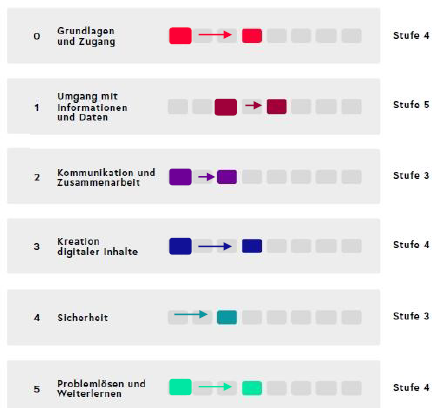 This model of a DigComp levels visualisation shows for each of the sechs main areas the entry requirements and exit perspectives for course antendees.
However, there are arguments against this approach.
It's advantage is that it is totally transparent. However, it requires some familiarity with the system of classification of digital skills (as provided by DigComp). The ordinary adult education participants may not have this.
And also, some colleagues are concerned that making the topic of "digital skills" so visible in a course announcement, might even deter potential customers, because they want everything else but being bothered with computers, mobile phones in their leisure time in adult education.
Hence, we are yet undecided how to proceed.
Perhaps a solution could be to provide the detailed information about entry and exit levels (as depicted above), but the not force the information on everybody reading the course description, rather hiding it behind a link that the reader would need to click actively... ?
Deciding this is one of our tasks for the remainder of the year 2025...